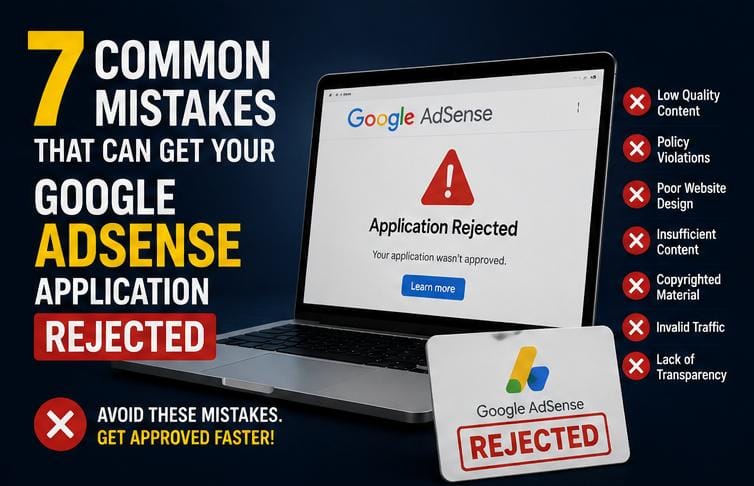
7 Common Mistakes That Can Get Your Google AdSense Application Rejected
Getting approved for Google AdSense is one of the most rewarding milestones for website owners and new bloggers in Nigeria. AdSense allows creators to monetize their web traffic by displaying targeted advertisements. However, many site owners face sudden rejection due to common Google AdSense approval mistakes that violate quality guidelines.

If you recently launched a blog or plan to monetize your existing traffic, learning how to avoid these critical Google AdSense approval mistakes can significantly increase your chances of passing Google’s review process on your first attempt.
Table of Contents
10 Critical Google AdSense Approval Mistakes You Must Avoid
1. Publishing Low-Quality or Thin Content
One of the primary causes of “Low Value Content” rejection is thin or poorly researched material. Google demands original, thorough content that provides genuine answers to user search queries.
Very short articles (under 300 words) rarely offer enough depth to pass review. To raise your standards:
- Write comprehensive, long-form guides that thoroughly address search intent.
- Break up text logically using descriptive H2 and H3 subheadings.
- Provide clear real-world examples and practical solutions.
- Proofread thoroughly to eliminate spelling or grammatical errors.
2. Copying Content From Other Websites
Plagiarism is a major policy violation. Google’s web crawlers quickly spot duplicate content, leading to swift application denials. Copying news, graphics, or text from competitor platforms severely damages your search engine credibility.
Instead of duplicating work, draft articles in your own words, express unique perspectives, cite reputable external sources properly, and create original visual assets using graphics design tools.
3. Missing Essential Website Pages
Professional websites must provide clear information about their operations and privacy standards. Failing to create mandatory administrative pages is one of the most overlooked Google AdSense approval mistakes beginners make. Compliance with official Google AdSense Program Policies is strictly monitored during site audits.

Before submitting your web portal for review, publish these four mandatory pages:
- About Us: Explains your team, mission, and content focus.
- Contact Us: Details valid email addresses or contact forms.
- Privacy Policy: Informs readers how user cookies and data are handled.
- Terms & Conditions: Outlines rules for site visitors.
4. Poor Navigation and Bad User Experience
Google prioritizes user experience. Cluttered design, broken hyperlinks, confusing color palettes, or broken menu bars lead to immediate rejection under “Deceptive Navigation” policies.
Ensure your site uses a responsive, mobile-friendly WordPress theme, organizes articles into clear menu categories, avoids intrusive popups, and makes navigation seamless across mobile screens.
5. Placing Excessive Ads Before Approval
Attempting to monetize early with third-party ad networks, pop-under scripts, or aggressive affiliate banners gives your site a spammy appearance. Google expects your site to focus on delivering user value over ad placements during the review window. Avoiding pre-approval ad spam is essential to bypass severe Google AdSense approval mistakes.
6. Applying With Very Few Published Articles
Submitting a newly launched blog with only 3 or 4 published posts will almost certainly result in an “Incomplete Site” flag. While Google does not enforce an official minimum post limit, a mature blog should feature:
- 15 to 25 fully developed, high-quality articles.
- A steady publishing history over several weeks.
- Balanced post distribution across your primary categories.
7. Slow Page Speed and Poor Optimization
Page loading speeds directly impact user retention and SEO performance. Sites with heavy uncompressed assets or excessive scripts frustrate visitors, triggering low-quality user experience flags.
Improve site speed by compressing uploaded images into WebP formats, using lightweight themes, removing redundant plugins, and utilizing speed-optimized web hosting.
8. Copyright Violations and Unlicensed Visuals
Downloading copyrighted stock images straight from search engines without permission risks severe copyright strikes. Utilize royalty-free media platforms (such as Unsplash or Pexels) or design customized banners on Canva to keep your site completely compliant.
9. Inconsistent or Unfocused Niche Content
Mixing completely unrelated categories (e.g., publishing crypto signals today, local celebrity news tomorrow, and cooking recipes the next day) prevents crawlers from identifying your domain authority. Focus on a defined core niche—such as tech, finance, education, or blogging—to build topical authority.
10. Applying Too Early Without Domain Maturity
Rushing to apply for monetization immediately after purchasing a domain frequently leads to disappointment. Preventing these technical Google AdSense approval mistakes gives your site time to index properly on Google Search Console, fix technical crawl errors, establish internal linking structures, and build baseline organic search traffic before submitting your application.
Why Sustainable Content Beats Online Quick-Fix Schemes
Building a fully approved AdSense blog requires patience, original research, and commitment. Many online users attempt to skip this foundational effort by joining unverified pay-to-earn schemes. However, history shows that skill-based content platforms remain far more reliable over time.
As highlighted in our analysis of is DXTUNE legit or risky, platforms that rely on subscription fees rather than verifiable external business revenue carry continuous financial risks. Similarly, our evaluation on whether is CPMeta legit or risky demonstrates how focusing on building genuine digital assets—such as an AdSense-approved website—is always a safer, long-term strategy.
By taking your time to fix these common Google AdSense approval mistakes, you position your blog for reliable long-term monetization and sustainable search engine growth.
Frequently Asked Questions (FAQ)
How many articles are required for AdSense approval?
There is no rigid official figure, but publishing 15 to 25 detailed, unique posts drastically improves approval rates.
Does Google reject blogs with thin or short content?
Yes. Thin articles that lack original insights or fail to address search intent are routinely rejected under AdSense’s Low Value Content policy.
How long does the Google AdSense evaluation process take?
Review times vary depending on site traffic and crawl queues, usually taking anywhere from 48 hours to 2 weeks.